Polar is the best payment provider for selling software for most developers in October 2026. It acts as the merchant of record, so it collects, files and pays sales tax and VAT on every sale; it has every billing feature we scored, from usage-based billing to license keys; and it is the only merchant of record here that documents how to export your subscribers' saved cards if you leave. Pick Creem instead if keeping the most of each sale matters more: at 3.9% + 40¢ with no surcharge for non-US cards, it keeps $9.21 of a $10 sale and $94.96 of a $100 renewal from a buyer in Germany, the most of any provider that handles tax for you.
Plain Stripe has the lowest fees on US sales, keeping $9.41 of a $10 sale, and narrowly the lowest on average, but you remain the seller, and a US developer owes EU VAT from the first sale to a consumer in the EU. Pick it only if you are ready to register and file, or pay Stripe or an accountant to. Dodo Payments, Creem and Paddle follow within 0.6 points of Polar. Fungies and Freemius, two smaller merchants of record, rank seventh and eighth, and Gumroad, at 10% + 50¢ plus card fees, takes about twice what the others do.
What you keep from a $10 and a $100 sale
These are the amounts each provider pays you from one sale, worked out from its published price list on October 21, 2026. The list price is in US dollars with tax added on top, and the buyer pays in US dollars by card. The US buyer is in Oregon, which has no sales tax; the German buyer pays 19% VAT and uses a card issued outside the US.
| Provider | $10 one-time, US buyer | $100 one-time, US buyer | $10 one-time, German buyer | $100 monthly renewal, German buyer |
|---|---|---|---|---|
| Polar | $9.00 | $94.50 | $8.73 | $91.77 |
| Dodo Payments | $9.20 | $95.60 | $8.95 | $92.46 |
| Creem | $9.21 | $95.70 | $9.14 | $94.96 |
| Paddle | $9.00 | $94.50 | $8.90 | $93.55 |
| Stripe | $9.41 | $96.80 | $9.12 | $93.04 |
| Lemon Squeezy | $9.00 | $94.50 | $8.73 | $91.17 |
| Fungies | $9.00 | $94.50 | $8.90 | $93.55 |
| Freemius | $8.77 | $92.20 | $8.63 | $90.81 |
| Stripe Managed Payments | $9.06 | $93.30 | $8.76 | $89.47 |
| Gumroad | $7.91 | $86.30 | $7.85 | $85.75 |
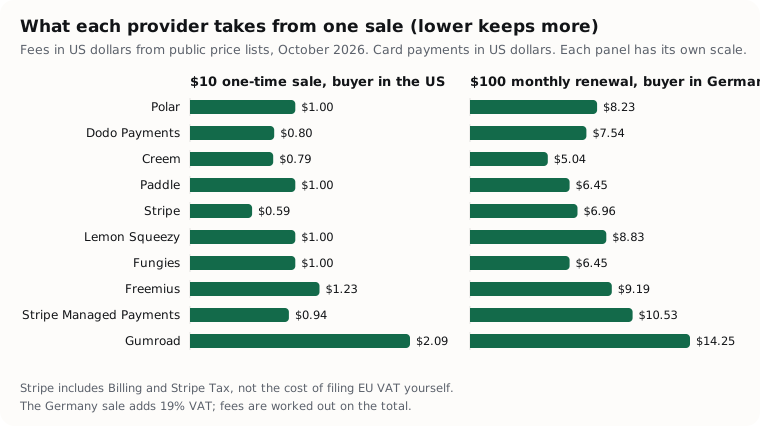
Three things in the price lists move these numbers more than the headline rate:
- Fees are charged on the total, tax included. On a $100 sale to Germany the buyer pays $119, and every provider that says how it charges takes its percentage from the $119. Paddle's fee there is $6.45, not the $5.50 that 5% + 50¢ of $100 suggests (Paddle's earnings example works the same way). Stripe card fees apply to the amount charged too.
- Surcharges for non-US buyers and subscriptions. Polar, Lemon Squeezy and Dodo Payments add 1.5% for international cards or buyers, and Lemon Squeezy and Dodo Payments add 0.5% on subscription payments. Paddle, Creem and Fungies add nothing, which is why Paddle and Fungies overtake Polar on the German sales.
- The fixed part of the fee. 50¢ is 5% of a $10 sale on its own. On cheap products the providers charging 40¢ (Creem and Dodo Payments) or 30¢ (Stripe) pull ahead.
Stripe's numbers include Stripe Billing (0.7% on subscriptions) and Stripe Tax Basic (0.5% where you're registered) but not the cost of filing tax returns yourself. Freemius' figures add Stripe's or PayPal's processing fee at the 3.5% average Freemius gives, since it publishes no exact rate. The scoring sheet has all eight sales we scored, including $10 and $100 renewals for both buyers, and the fee formula for each provider.
What the table leaves out
The table counts the fee on each sale and nothing else. Five other costs differ between providers:
- Disputes. When a buyer disputes a charge, Stripe, Polar and Lemon Squeezy charge $15, Paddle $20, which it keeps even when it wins (Paddle chargebacks), Creem $25 and Dodo Payments $30. Freemius passes on the processor's $15 to $20 when a dispute is lost, Fungies charges nothing, and Stripe Managed Payments applies Stripe's standard dispute fees.
- Refunds. Polar keeps its transaction fee when you refund (Polar fees), and Freemius returns its 3.8% but keeps its 50¢ and the processor's fee. Lemon Squeezy says "The refunded amount (minus our platform fee) will be deducted from your next payout" (refunds and chargebacks), which reads as Lemon Squeezy giving up its own fee.
- Refunds you don't approve. Polar and Lemon Squeezy both reserve the right to refund a buyer at their own discretion up to 60 days after purchase, to head off chargebacks. Stripe Managed Payments may refund a buyer if you don't answer a support escalation within 48 hours.
- When the money arrives. Stripe pays a sale out 2 business days later, after a first payout that takes 7 to 14 days (Stripe payouts). Paddle can take about six weeks and Freemius pays a month's sales on the 10th of the month after next. The table treats them the same; your bank balance doesn't.
- Currency conversion. We priced everything in US dollars. Stripe adds 1% when it converts a currency; we didn't score the merchants of record's conversion margins, so check them if you price in euros or get paid in another currency.
Merchant of record or payment processor?
The biggest decision is which kind of provider to use. A payment processor such as Stripe charges the card and pays you; you are the seller, so sales tax and VAT are yours to collect, report and pay. A merchant of record (Polar, Paddle, Creem, Dodo Payments, Lemon Squeezy, Fungies, Freemius, Gumroad, and Stripe Managed Payments) buys the sale from you and resells it to the buyer, so it is the legal seller and owes the tax. You usually pay for that in a higher fee: across our eight sales Stripe's fees averaged 6.4% of the price, the merchants of record 6.5% (Creem) to 10.7% (Freemius), and Gumroad 17.6%. Creem actually beats Stripe on both German sales, because Stripe adds 1.5% for the non-US card and 0.5% for Stripe Tax.
Tax is why that is usually worth it for a solo seller of software. A business established outside the EU that sells digital services to EU consumers has to charge VAT from its first sale, register for the EU's One Stop Shop and file a return every quarter; the €10,000 threshold people quote applies only to businesses established in an EU country. US sales tax works state by state: each state decides whether software is taxable and when an out-of-state seller has to start collecting. With a merchant of record none of that is yours. With Stripe you can automate the calculation for 0.5% of each sale, but the registrations and returns are still yours, or Stripe Tax Complete's at $90 a month and up (Stripe pricing).
What a merchant of record changes for your buyers: its name, not yours, appears on the receipt and often on the card statement, it handles payment disputes and refund requests, and it decides which businesses it will sell for. Polar notes in its merchant of record introduction a side effect worth knowing: because the merchant of record collects tax everywhere it is owed, more of your buyers pay tax than if you sold directly and stayed under local thresholds.
The best payment providers for selling software, ranked
Polar
Polar is No. 1 because it is the most complete package: a merchant of record with usage-based billing, license keys, seat-based pricing and a customer portal, plus a way out. Polar's migrate-away guide says its support team will export your customers' saved cards to another Stripe account or, through Stripe's card export, to any PCI-compliant processor. Without a card export, moving a subscription business means asking every subscriber to type in a card again, and some won't. One caveat: Stripe's export leaves out cards saved through Link, Stripe's saved-card wallet, and Polar doesn't say whether its checkout saves cards that way, so ask Polar before you count on the exit.
Polar's weakest score is cost (5.7 out of 10). New sellers start on the Starter plan at 5% + 50¢, plus 1.5% for international cards, charged on the total including tax (Polar fees). That is the same as Paddle for US buyers ($9.00 kept from $10) and more for everyone else: $8.23 on a $100 renewal from Germany, against $6.45 at Paddle and $5.04 at Creem. Monthly plans lower the rate: Pro at $20 a month charges 3.8% + 40¢, which pays for itself at about $1,400 a month in sales. Organizations created before May 27, 2026 keep an older Early Member rate of 4% + 40¢.
Two things to know before you start. Payouts reach you through a Stripe account you connect, as a withdrawal you start yourself, after a 7-day settlement delay, with Stripe's fees of $2 for each month you take a payout plus 0.25% + 25¢ per payout (Polar payouts). And the exit has a cost: Polar pauses payouts for 120 days after a migration, and you have to recreate your products and subscriptions at the new provider.
Dodo Payments
Dodo Payments is No. 2 and the best of the merchants of record on US sales after Creem. At 4% + 40¢ it keeps $9.20 of a $10 sale and $95.60 of $100 (Dodo Payments pricing). It matches Polar feature for feature, including usage-based billing, license keys and seat-based pricing, and it accepts sellers from 177 countries (accepted countries). Payouts go out twice a month by default: sales from the 1st to the 15th are paid on the 18th, the rest on the 4th (payout structure).
The surcharges are the catch on cost: 1.5% for international payments and 0.5% on subscriptions bring a $100 renewal from Germany to $7.54 in fees, more than Paddle's $6.45. Dodo Payments' weakest score is leaving (2 out of 10): its migration guide covers moving subscribers in, and we found nothing documented about taking saved cards out. Smaller fees to know about: $5 for a payout under $1,000, $1 per refund and $30 per dispute.
Dodo Payments trails Polar by less than half a point, and only because of the card export. If you sell one-time downloads and have no subscribers to move, Dodo Payments is the better pick of the two.
Creem
Creem is No. 3 and the cheapest way to have someone else handle your sales tax and VAT. It charges 3.9% + 40¢ with no extra fee for international cards or subscriptions (Creem pricing), so it keeps $9.21 of a $10 sale and $94.96 of a $100 renewal from Germany, more than any other merchant of record on every sale we scored. Its billing features match Polar's: trials, usage-based billing, license keys, a customer portal and seat-based billing.
Creem's weakest score is getting paid (4 out of 10). It accepts sellers in 87 countries (supported countries). Payouts go out only on the 1st and 15th after you ask for one, payments "may be held for 7-12 days for risk assessment" first, so a sale can wait close to four weeks, and each payout costs $7 or 1%, whichever is higher (Creem payouts). Two payouts a month cost at least $14, so at low volume the payout fee eats into Creem's lower rate; asking for one payout a month halves it. Chargebacks cost $25. Like Dodo Payments, Creem documents no card export.
One inconsistency to be aware of: Creem's documentation says it remits tax in more than 190 countries (introduction), while its pricing page says 50+. As merchant of record it is the seller on every sale either way.
Paddle
Paddle is No. 4, level with Creem on 7.6 and listed after it because its unrounded total is 0.02 lower. It is the merchant of record AI assistants named most (12 of our 16 answers), and its pricing is the simplest here: 5% + 50¢ per sale, with no monthly fee and no surcharge for international cards or subscriptions (Paddle pricing). That flat rate makes Paddle cheaper than Polar, Lemon Squeezy and Dodo Payments on our German sales. It sells in almost every country and accepts sellers from almost every country (supported countries).
Paddle's weakest scores are billing features (7) and leaving (5). Paddle Billing has subscriptions with trials and proration and a customer portal, but no license keys, and its native usage-based billing is "in early access (beta)". Outside the beta you add one-time charges to bill usage, so we score it as a workaround; if metering opens to everyone, Paddle moves up to second. Its pricing page promises "your data is 100% yours and can be migrated to another provider if needed", with no lock-in period, but Paddle publishes no procedure for exporting saved cards. Providers that import from Paddle describe one: Dodo Payments' migration guide says the export comes from IXOPAY, the company that stores Paddle's cards, so ask Paddle before you rely on it.
Paddle is also the slowest to pay: your balance converts on the 1st of each month and is sent by the 15th, with a $100 minimum, so a sale made on the 2nd can wait about six weeks (when and how you get paid). Chargebacks cost $20, and Paddle keeps the fee even when it wins. Products under $10 can ask Paddle for bespoke pricing.
Stripe
Stripe used on its own is No. 5, with the lowest fees on US sales and the best exit, and the only pick where you are the seller. Cards cost 2.9% + 30¢, plus 1.5% for international cards; subscriptions add 0.7% for Stripe Billing; and Stripe Tax Basic adds 0.5% on sales where you're registered (Stripe pricing). Even with all of that, Stripe keeps the most on every US sale ($9.41 of $10, $96.80 of $100). Creem keeps slightly more on the German sales, so Stripe's lead on average is narrow: 6.4% against 6.5%. Your saved cards stay in your own account, and Stripe documents exporting card data to another processor, except cards buyers saved through Link, its saved-card wallet; you can turn Link off in Checkout if the exit matters to you. US accounts are paid out 2 business days after a sale, once the first payout, which takes 7 to 14 days, has gone through (Stripe payouts).
Stripe's weakest score is tax handled (5 out of 10), and it decides its place: with no weight on tax, Stripe would be first. Stripe Tax calculates and collects the tax, but you register in each place you owe it and file the returns, including the EU VAT return that starts with your first sale to an EU consumer. Stripe Tax Complete takes over registrations and filings in more than 90 countries from $90 a month on a one-year contract. Stripe has usage-based billing, a customer portal and quantity pricing, but no license keys.
Lemon Squeezy
Lemon Squeezy is No. 6. It has every billing feature we scored, including license keys and usage-based billing, free payouts to US bank accounts, and PayPal payouts in more than 200 countries (supported countries). Its surcharges make it one of the dearer merchants of record: 5% + 50¢ on the total, plus 1.5% for buyers outside the US, 1.5% for PayPal and 0.5% on subscriptions (Lemon Squeezy fees), which comes to $8.83 on a $100 renewal from Germany. Each chargeback costs a $15 dispute fee, and Lemon Squeezy "reserves the right to issue refunds within 60 days of purchase, at its own discretion, in order to prevent chargebacks" (refunds and chargebacks).
The main reason to hesitate is one the scores don't capture. Stripe bought Lemon Squeezy in 2024, and in a January 2026 update its team said it had spent the year building Stripe Managed Payments, acknowledged "slower support responses and less frequent product updates", and wrote: "Our goal is to provide Lemon Squeezy users an easy way to migrate to Stripe Managed Payments." No shutdown has been announced, but a new seller choosing Lemon Squeezy today should expect to move. Lemon Squeezy documents no card export of its own (its leaving score is 2); Dodo Payments' migration guide says cards at Stripe-based platforms such as Lemon Squeezy can be exported through a Stripe request, so ask Lemon Squeezy before you assume either way.
Fungies
Fungies is No. 7. It charges a flat 5% + 50¢ per sale with no surcharge for international cards, subscriptions or PayPal (Fungies pricing), so it keeps the same as Paddle on every sale we scored: $9.00 of a $10 sale and $93.55 of a $100 renewal from Germany. That assumes the 5% comes off the total including tax, as it does at every provider that says; Fungies doesn't say, and if it charges on the list price instead it keeps $94.50 of that renewal and moves up to sixth. It pays fastest of the merchants of record: daily by default to a Stripe account you connect, once a first payout 7 to 14 days after your first sale has cleared, with no payout fee and no dispute fee (Fungies payouts).
Fungies' weakest scores are billing features (7) and leaving (2). It has subscriptions with free trials and prorated plan changes, and a customer portal where buyers update their card, change plan and cancel. But usage billing means sending extra charges to a subscription through its API, its key tools are built around game and license keys you upload rather than keys it generates, and seats need a custom checkout field. Buyers pay into Fungies' own Stripe account, and we found no documented card export.
Freemius
Freemius is No. 8. It is a merchant of record that handles US sales tax and UK and EU VAT (what Freemius does), and it has nearly every billing feature we scored: trials with or without a card, proration, license keys with activation, a customer portal and multi-unit pricing. Usage is sold as prepaid credit top-ups that you track yourself. It pays sellers in more than 190 countries, by PayPal, Payoneer, Wise or wire, with no payout fee (supported countries).
Freemius' weakest score is cost (4.4). It charges 3.8% + 50¢ on the total including tax, plus Stripe's or PayPal's processing fee at cost, which it puts at "an average effective rate" of 3.5% (Freemius pricing). On that average it takes $1.23 of a $10 sale, more than anyone but Gumroad. It is also the slowest to pay: a month's earnings are worked out on the 1st of the month after next and paid on the 10th, so a sale on January 1 is paid on March 10 (your earnings). Freemius says the wait lets refunds and disputes surface, and it offers faster payouts with a rolling reserve to some new AI products, case by case. Its migration guides cover moving in, and we found no documented card export. Freemius grew up selling WordPress plugins and themes, where its WordPress & Templates service costs 2.3% more.
Stripe Managed Payments
Stripe Managed Payments is No. 9: Stripe's own merchant of record, generally available since April 2026. You turn it on in your existing Stripe account, Stripe (through its Link brand) becomes the seller, and Stripe handles tax compliance in more than 80 countries by its documentation, or "75+" by its pricing FAQ. Your customers and their saved cards stay in your own Stripe account, but the checkout uses Link, and Stripe's card export says "We exclude any credentials saved through Link from our exports". So it scores 4 for leaving: the cards are in your account, but we found no documented way to move them.
Managed Payments' weakest score is cost (5.1). It adds 3.5% on the full amount including tax to Stripe's usual card fees, plus 0.7% on subscriptions (Managed Payments pricing), so a $100 renewal from Germany costs $10.53, the most of any provider except Gumroad. Stripe's standard dispute fees may apply on top. In countries Managed Payments doesn't cover, the tax is still yours, which is why it scores 8 rather than 10 for tax.
Other limits: it works only with Stripe Checkout and Payment Links, existing subscriptions can't be switched to it (updating a Checkout integration), buyers see "Sold through Link" and LINK.COM* on their statements, and Stripe may refund a buyer without asking you if you don't answer a support escalation within 48 hours. It is open to businesses in 37 countries by its eligibility page.
Gumroad
Gumroad is No. 10. It is the quickest way to sell a download to an audience you already have, it "now acts as the Merchant of Record for all sales" (sales tax on Gumroad), and on its weekly schedule it pays out each sale after a 7-day hold, free to a bank account (getting paid). It has license keys and memberships with tiers, free trials and seats.
Gumroad's cost scores 0. It charges "10% + $0.50 fee + sales tax per transaction", plus card processing of 2.9% + 30¢, and a flat 30% on sales that come through its Discover marketplace (Gumroad's fees). That takes $2.09 of a $10 sale and $13.70 of a $100 sale, about twice what the others take. Once your paid sales in a calendar month reach $20,000, further direct sales that month cost 5% + 50¢, plus card processing, and the count starts again each month.
Which one should you choose?
- You sell a SaaS subscription and want tax off your plate: Polar. You get every billing feature and the only documented card export among the merchants of record, so you're not locked in.
- You want the lowest fees with tax handled, and payout costs don't worry you: Creem. It keeps the most on every sale we scored among merchants of record, with no surcharge for non-US buyers.
- You sell one-time downloads or licenses, mostly to US buyers: Dodo Payments or Creem. With no subscribers to move, the card export that puts Polar first doesn't matter.
- Most of your buyers are outside the US and you sell subscriptions: Paddle, Creem or Fungies, the three with no international or subscription surcharge.
- You sell licensed desktop software or plugins: Freemius has license keys with activation, trials and free payouts to more than 190 countries, if you can wait up to 10 weeks for each sale's money.
- You are already registered for tax, have an accountant, or sell mainly to businesses: Stripe. It keeps the most on US sales, pays fastest and lets you leave with your data. Business buyers in the EU account for their own VAT under the reverse charge, so the first-sale problem mostly applies to consumers.
- You already run on Stripe Checkout and want tax handled for new customers without moving: Stripe Managed Payments, if you can live with some of the highest fees here, Link's name on your buyers' statements and cards you can't export.
- You are on Lemon Squeezy today: nothing forces a move yet, but plan for one. Its team says the path leads to Stripe Managed Payments.
- You are selling a first ebook or template to your own followers: Gumroad is the least setup, but the fee is the price of that. Move once sales are steady.
What AI answers get wrong
We asked GPT, Claude, Gemini and Perplexity models four versions of this question through their APIs in October 2026 (16 answers; the questions are in the scoring sheet), plus a Stripe, Lemon Squeezy, Paddle and Polar comparison question earlier the same day (four more answers). Most recommend Paddle, Stripe or Lemon Squeezy, and most list the headline fees correctly. These are the claims the price lists contradict, or the gaps that change the answer:
- Polar at 4% + 40¢. Two answers presented this as Polar's rate, one of them from Polar's older documentation. It is the Early Member rate for organizations created before May 27, 2026. New sellers pay 5% + 50¢, plus 1.5% for international cards (Polar fees). One answer gave both figures for a $10 sale, saying you keep $9.20 and then $9.00; $9.00 is right.
- Creem in "only about 50 countries". One answer said this, citing a third-party comparison page. Creem accepts sellers in 87 countries and says it remits tax in more than 190; its own pricing page says 50+, which is probably where the figure comes from.
- Dodo Payments in "220+ countries". Two answers used this figure without saying what it counts. It is where buyers can pay from, by Dodo Payments' own introduction. Sellers have to be based in one of the 177 countries on its accepted list.
- Stripe Tax doesn't file returns. One answer said Stripe Tax "does not file or remit" tax. Stripe Tax Basic doesn't, but Stripe Tax Complete registers and files in more than 90 countries, from $90 a month (Stripe pricing). You stay the seller either way.
- "You can always migrate to Stripe later." One answer advised starting on Lemon Squeezy or Paddle for this reason. Neither documents a card export of its own. Providers that import from them describe exports on request (from IXOPAY for Paddle, through Stripe for Lemon Squeezy), but nothing on Paddle's or Lemon Squeezy's own pages promises one, so ask before you commit. Only Stripe and Polar document an export themselves, and no answer said which providers let you take saved cards with you.
- Fees on the tax-inclusive total. Only one of the 16 answers noted that fees apply to the amount including tax, and none of the worked examples included a buyer who pays VAT, where the difference between providers is widest.
- Lemon Squeezy's direction. Two of the 16 answers flagged slower updates or uncertainty since Stripe bought it, and one of them noted its team is building Stripe Managed Payments. None of the 16 said the team's stated goal is to move Lemon Squeezy users there; one of the four earlier answers did.
How we scored
Every score on this page comes from desk research: pricing pages, fee and payout documentation, help centers and migration guides, all read on October 21, 2026. We didn't open accounts or run checkouts, so the scores don't cover how a checkout converts, how often a provider freezes accounts or how good its support is.
Cost is arithmetic: for each provider we worked out the fee on eight sales ($10 and $100, one-time and subscription renewal, to a US buyer and to a consumer in Germany paying 19% VAT) and averaged the fee as a share of the list price. A 4% average scores 10 and 16% scores 0. The other four criteria follow anchors written before scoring: 10 for tax when the provider is the merchant of record everywhere, two points for each of five billing features, six points for a documented card export, and so on. The scoring sheet has the anchors, the fee formulas, the full table of what each provider keeps and the source behind every score.
How close is it? Polar leads Dodo Payments by 0.44 points before rounding, and all of it comes from the card export. Moving seven of the 100 weight points from Leaving to Cost would put Dodo Payments first, Creem second and Polar third. If you will never need to move your subscribers, read the ranking with that in mind. Two single scores could also change the order: if Paddle's usage-based billing leaves beta, Paddle moves to second (7.70 against Dodo Payments' 7.67), and if you count the Link exclusion against Stripe's card export, Stripe falls from fifth to seventh.
Questions people ask
Is Lemon Squeezy shutting down?
No shutdown has been announced. But its team wrote in January 2026 that it has been building Stripe Managed Payments and that "Our goal is to provide Lemon Squeezy users an easy way to migrate to Stripe Managed Payments" (Lemon Squeezy's 2026 update). Choosing it now means planning for that move.
Is Polar cheaper than Stripe?
No. On a $10 sale to a US buyer, Polar's Starter plan takes $1.00 and Stripe $0.59, and on a $100 sale $5.50 against $3.20. The difference pays for Polar being the merchant of record: Stripe leaves sales tax and VAT registrations and filings to you. Polar's Pro plan, at $20 a month, cuts its fee on a $10 US sale to 78¢.
What is the cheapest merchant of record?
Creem, on every sale we scored: 3.9% + 40¢ with no surcharge for international cards or subscriptions, so it takes 79¢ of a $10 sale and $5.04 of a $100 renewal from Germany. Dodo Payments is level on a $10 US sale (80¢) and dearer once its surcharges apply. Count Creem's payout fee of $7 or 1% when you compare.
Do I need a merchant of record if I only sell in the US?
Often not at first. Each US state decides whether software and SaaS are taxable and when an out-of-state seller has to start collecting, so many small sellers owe little or nothing until sales into a state grow. Your own state is the exception: if you are based in a state that taxes software or SaaS, you can owe tax there from your first sale to a buyer in that state. The EU is different: a US seller owes VAT from the first sale to an EU consumer. If you sell worldwide from day one, a merchant of record saves the most work.
Can I switch payment providers later without losing subscribers?
Only if your current provider will export your customers' saved cards. Stripe documents a card export from your own account (except cards saved through Link), and Polar documents one through its support team. Paddle promises your data can be migrated but publishes no procedure, and Lemon Squeezy, Creem, Dodo Payments, Fungies, Freemius and Gumroad document none. Importing providers say Paddle's and Lemon Squeezy's cards can be exported on request, but without the provider's own word, plan for some subscribers having to pay again. If you sell subscriptions, ask about the exit before you take the first payment.
How the score is built
Weighted average of the criteria below, out of 10
- Cost 30%
- The average fee as a share of the list price across eight sales ($10 and $100, one-time and subscription renewal, a US buyer and a consumer in Germany paying 19% VAT), from each published price list. 10 at 4% or less, 0 at 16% or more.
- Tax handled 30%
- How much of the sales tax and VAT work the provider takes on. 10 when it is the legal seller (merchant of record) everywhere, 8 when it leaves some countries to you, 5 when it calculates and collects tax but you stay the seller.
- Billing features 15%
- Two points each for subscriptions with trials and proration, usage-based billing, license keys, a customer portal, and seat or quantity pricing, from each provider's documentation.
- Leaving 15%
- Whether the provider documents exporting your customers' saved cards to another processor (6 points, 3 for a promise without a procedure), keeps cards in an account you own (2) and lets you export customer and order records (2).
- Getting paid 10%
- How many seller countries it accepts, the longest wait from a sale to a payout on the default schedule, and what a payout to a US bank costs.
| Tool | Cost30% | Tax handled30% | Billing features15% | Leaving15% | Getting paid10% | Score |
|---|---|---|---|---|---|---|
| Polar | 5.7 | 10.0 | 10.0 | 8.0 | 7.0 | 8.1 |
| Dodo Payments | 6.9 | 10.0 | 10.0 | 2.0 | 8.0 | 7.7 |
| Creem | 7.9 | 10.0 | 10.0 | 2.0 | 4.0 | 7.6 |
| Paddle | 6.5 | 10.0 | 7.0 | 5.0 | 8.0 | 7.6 |
| Stripe | 8.0 | 5.0 | 8.0 | 10.0 | 8.0 | 7.4 |
| Lemon Squeezy | 5.5 | 10.0 | 10.0 | 2.0 | 8.0 | 7.3 |
| Fungies | 6.5 | 10.0 | 7.0 | 2.0 | 9.0 | 7.2 |
| Freemius | 4.4 | 10.0 | 9.0 | 2.0 | 8.0 | 6.8 |
| Stripe Managed Payments | 5.1 | 8.0 | 7.0 | 4.0 | 6.0 | 6.2 |
| Gumroad | 0.0 | 10.0 | 8.0 | 2.0 | 9.0 | 5.4 |
Also considered: 8 tools we left out
- FastSpring
- No public price list. Its pricing page asks for a business email to get a quote, so its fees can't be checked or compared.
- PayPal
- A payment method and processor, not a merchant of record. Most providers here accept PayPal at checkout.
- Chargebee and Recurly
- Billing software that runs on top of a payment processor such as Stripe, not payment providers in their own right.
- RevenueCat
- Subscription software for apps sold through the App Store and Google Play, which sits on top of those stores and other processors.
- 2Checkout (Verifone)
- Its plan that handles tax and compliance (2Monetize) has tailored pricing only. The published 2Sell and 2Subscribe rates don't include tax compliance, so the comparable plan can't be checked.
- PayPro Global and Cleverbridge
- No public price list. Both ask you to contact them for a quote, so their fees can't be checked or compared.
- Braintree
- A payment processor owned by PayPal, not a merchant of record. It leaves tax to you, as plain Stripe does.
- Xsolla
- A merchant of record built for video games, not general software or SaaS.