YNAB is the better budgeting app for most people choosing between the two, at $109 a year against $99.99 for Monarch Core. Pick YNAB if you want to budget the money that is in your account today, especially on a tight or irregular income or while paying off a credit card. Pick Monarch if your spending is already under control and you want every account, including investments and the value of your home, in one view you share with a partner. On our budgeting rubric YNAB scores 7.8 and Monarch 7.4: they tie on budgeting tools, price, sharing and platforms, and YNAB's whole lead comes from file imports and from exporting your whole budget. If you'll never import a bank file or leave, treat the scores as a tie.
That gap is small, but it can't be closed by weighing the criteria differently, because Monarch doesn't score higher than YNAB on any of them. So the real choice is decided by three things a score can't settle: which money you budget, whether you want your investments in the same app, and which partner, if any, needs a private plan. This page uses the same criteria and scores as our ranking of the best budgeting apps, where YNAB is No. 1 and Monarch No. 3.
The real difference: which money you budget
YNAB budgets the money you already have; Monarch budgets the income you expect this month. Everything else follows from that.
In YNAB you give a job to dollars that are in your accounts now, until "Ready to Assign" reaches zero, and a paycheck gets its jobs when it lands (YNAB's comparison page describes its plan as "based on account balances"). In Monarch, "your total monthly budget is based on how much income you expect to receive that month", and Monarch says it "uses a cash flow-based approach rather than an account balance-based one", with account balances "used mainly for long-term goals" (Monarch's budget guide). Monarch builds the first budget for you from the average of your last six months of spending.
Here is the same made-up household in both apps two days after its first paycheck of the month:
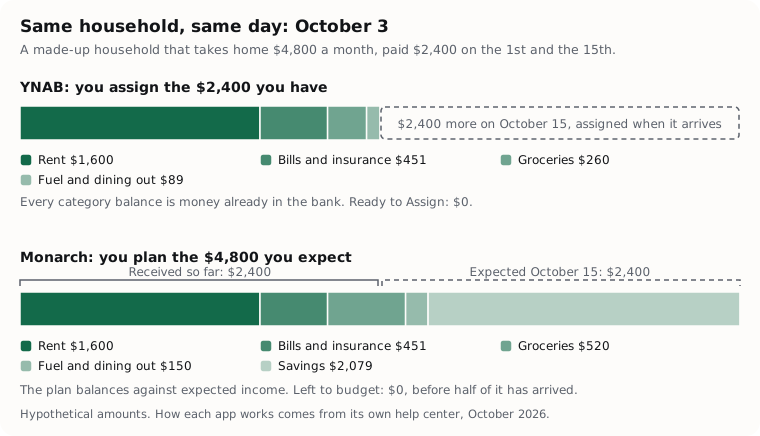
A hypothetical household, with the monthly amounts from our hands-on test of Actual Budget. Neither YNAB nor Monarch was used; how each behaves comes from its own help center, October 2026.
If the second paycheck is late or smaller, YNAB's categories still show only real money, while Monarch's budget still shows $520 of groceries left to spend. That is why YNAB fits people living paycheck to paycheck or with irregular pay, and why Monarch wrote in a 2022 post that its approach assumes you "earn more than you spend in a typical month". For a household with a cushion, Monarch's way is less work: you set the month once, and its default Flex budget lets you watch one number for flexible spending instead of every category (Monarch's Flex budgeting guide).
Credit cards show the same split. When you buy groceries on a card in YNAB, the money moves from Groceries to the card's payment category, so the bill is already covered when it comes (YNAB's credit card guide). Monarch counts the purchase as spending and treats the later payment as a transfer that doesn't touch the budget (Monarch's transfers guide); nothing in the budget sets cash aside for the bill. In the same 2022 post, Monarch recommended keeping two months of cash in the checking account that pays the card.
Both apps have the same budgeting tools on our checklist, so they score 10 each: rollover, goals with a monthly amount, upcoming bills, a debt payoff plan, and a way to bring the month to zero (YNAB's Ready to Assign, Monarch's "left to budget"). Monarch's newer Save up goals also let you set aside money that is already in an account (Monarch's goals guide), which is the closest it comes to YNAB's method.
Price: Monarch costs $9 a year less after the first year
Both score 2 on price: neither has a free plan, and both cost between $90 and $110 a year at the regular price.
| YNAB | Monarch Core | |
|---|---|---|
| Yearly | $109 | $99.99 ($69.99 the first year with code WELCOME) |
| Monthly | $14.99 | $14.99 |
| Three years, billed yearly | $327 | $269.97 with the code, $299.97 without |
| Five years, billed yearly | $545 | $469.95 with the code, $499.95 without |
| People covered | You and up to five others | Your whole household |
| Trial | 34 days, no card if you sign up with YNAB | 7 days, payment method required |
Prices from YNAB's pricing page and Monarch's pricing page, checked in October 2026. Both add tax where it applies. The WELCOME code is for new users on the yearly Core plan, and Monarch says it "may expire or be deactivated at any time". Paying monthly costs $179.88 a year with either app.
Monarch Plus, launched in April 2026, costs $199.99 a year with no monthly option. It adds forecasting, retirement planning, business tracking, deeper investment analysis and a will through Trust & Will (Monarch Plus). Nothing on our checklist needs it, so we score Core.
If you're unsure, Monarch's money-back guarantee refunds the unused part of a subscription at any time, except for subscriptions bought through Apple's App Store. YNAB's refund page promises no refund for a direct subscription: you can cancel and keep using it to the end of the period you paid for, or ask support. YNAB's longer trial without a card is the safer way to find out whether its method suits you.
Couples: Monarch shows everything, YNAB lets the payer keep a plan private
Both score 8 for couples, for different reasons, and which one suits you depends on how much you want to share.
Monarch puts the household in one space. Everyone you invite gets their own login at no extra cost, and "each household will share one dashboard and have the same view and budget". Shared Views mark each account and transaction as yours, your partner's or shared, and rules can assign owners or split one transaction between you, but the owner filters "are not available in Budgets, Recurring, Goals, or Investments". And "you cannot hide bank accounts or transactions" from household members (Monarch's couples guide). A hidden account "will still be visible to all members from the Institution Settings or if hidden accounts are expanded" (Shared Views guide). A partner who already has a Monarch account can't accept your invitation until they delete it or use another email.
YNAB lets you have as many separate plans as you like, so a couple can keep a joint plan beside personal ones, and Recent Moves shows who moved money. The catch is who can see what. YNAB Together has a group manager, the person who pays, and up to five members. The manager chooses which of their own plans to share, but "members' plans are always automatically shared with the group manager" (YNAB Together guide). So privacy runs one way: the person who pays can keep a plan private, and the partner they invite can't keep one from them. A member who wants a truly private plan needs their own subscription under another email. If only one of you wants privacy, make that person the group manager.
Neither app shows whose account is whose in the budget itself. If you want a shared view with yours, mine and ours labels, choose Monarch; if one of you needs a personal plan the other can't open, choose YNAB. If both of you need privacy, neither app gives it on one subscription; Honeydue, free and scored in our ranking, lets each partner choose what the other sees, though its budgeting is basic.
Net worth and investments: Monarch's clearest win
Monarch tracks investments; YNAB records their balance. This isn't one of our criteria, because the ranking is for people choosing a budgeting app, but for many people choosing between these two it is the deciding feature.
On the Core plan, Monarch pulls holdings from your brokerage, IRA and 401(k) accounts and shows performance and asset allocation (Monarch's investments guide), tracks your home's value through Zillow and crypto through Coinbase, and builds net worth from all of it (pricing page). Plus adds gains and losses by tax lot and fund analysis using Morningstar data.
YNAB's own advice is to leave investment accounts out: you plan contributions with a category, and add an account only if you want it in your net worth. Investment and retirement accounts "won't automatically import transactions due to the way the data is formatted from bank connections", so YNAB recommends adding them as unlinked accounts whose balance you update by reconciling (YNAB's investment accounts guide). Its Net Worth report then charts those balances alongside your cash and debts (Reflect in YNAB). That is fine for a total once a month, but it shows no holdings or returns.
Bank connections and imports: YNAB takes more kinds of file
YNAB scores 10 and Monarch 9. Both sync US and Canadian banks and connect Apple Card. YNAB links through Plaid or MX and also syncs banks in the UK and much of Europe (YNAB's pricing FAQ; Direct Import in Europe); Monarch uses Plaid, Finicity and MX and lets you switch provider bank by bank, but is available only in the US and Canada (Monarch's FAQs).
The point between them is file import. YNAB imports CSV, OFX, QFX and QIF files, and since September 2026 cleans up payee names and categorizes imported transactions the way it does synced ones (YNAB's file import guide). Monarch imports CSV only, on the web, and an import can't be undone (Monarch's import guide). That matters if your bank or credit union drops off sync and offers only a Quicken file.
Your data: YNAB exports your plan, Monarch keeps your history open
YNAB scores 8 and Monarch 6, and the two points are the budget export. YNAB exports your plan, with its categories, and your whole transaction history as two CSV files on the web; targets and category notes aren't included (YNAB's export guide). Monarch exports transactions and balance history, but not your budget, and lets you download that history even after your subscription or trial ends (Monarch's download guide).
Neither earns money from your data. YNAB's privacy policy says it does not "under any circumstances 'sell' the information you provide through the Product", and Monarch's pricing page says "we never sell your financial data" and shows no ads.
The two, scored
YNAB
YNAB is a better choice than Monarch for most people, because it is a budget built on money you have: it suits a tight or irregular income, it handles credit cards so the bill is always covered, and it takes every common bank file and gives you your whole plan back if you leave. It costs $109 a year with no free plan, and it is weaker than Monarch at tracking investments and at showing a couple whose money is whose.
Monarch
Monarch is the better choice for a household that already spends less than it earns and wants one shared picture of everything it owns, with investments, home value and net worth kept up to date for them. It costs $99.99 a year, or $69.99 for the first year with the WELCOME code. Its budget plans against expected income, so it guides day-to-day spending less closely than YNAB, and it imports only CSV files and doesn't export your budget.
Which should you choose?
- Your income is tight or irregular: YNAB. It never lets you assign money that hasn't arrived.
- You carry a credit card balance, or want the bill covered before it comes: YNAB.
- You mostly want to see where money went and how your net worth is moving: Monarch.
- You have a brokerage account, a 401(k) or a house you want tracked: Monarch Core. YNAB can only hold the balances you type in.
- You're a couple who share everything: Monarch, for one view with ownership labels and free logins for the whole household.
- One of you needs a plan the other can't open: YNAB, with that person paying as group manager.
- You live outside the US and Canada, or bank in the UK or Europe: YNAB. Monarch isn't available there.
- You want to try before paying: YNAB's 34 days need no card. Monarch's 7 days do, but it refunds the unused months if you cancel later.
- You want YNAB's method without paying for it: Actual Budget, No. 2 in our ranking, is free and open source, can import a YNAB budget, and needs a server you run or rent.
- You want both, YNAB to budget and Monarch to track: some people do; it costs $208.99 a year at the regular prices.
Switching from YNAB to Monarch, or back
Moving from YNAB to Monarch keeps your transactions but not your budget. Monarch's YNAB page says transactions, balance history, categories, notes and tags come across, and budget amounts, Age of Money and YNAB targets don't. There is no special YNAB importer: you export from YNAB and use Monarch's ordinary CSV import, which needs an Account, a Date and an Amount column, with money out as negative numbers in the same column as money in. YNAB's export puts money out and money in in separate Outflow and Inflow columns, with a currency symbol on each figure and $0.00 in the unused one (as documented by Beancount's YNAB converter). That converter's page says its mapping was verified against a real YNAB export, and YNAB's own import uses the same Date, Payee, Memo, Outflow and Inflow fields. So before importing, add an Amount column in a spreadsheet that is Inflow minus Outflow, as plain numbers, then delete the Outflow and Inflow columns: Monarch's importer stops when a required field is missing or duplicated. A transfer between two YNAB accounts comes out as one row in each, so mark those as transfers in Monarch. Import a small file first, since an import can't be undone, and choose how Monarch treats dates it already has from your linked banks so you don't get duplicates.
Moving from Monarch to YNAB means starting the plan again. Monarch exports transactions but no budget, and YNAB imports files one account at a time, so split Monarch's all-accounts download by account first. YNAB reads Monarch's single Amount column if you pick it for both Inflow and Outflow. Monarch's categories don't come across (YNAB guesses each payee's usual category instead), and YNAB doesn't recommend importing more than a year of history (YNAB's file import guide). Most people link their banks, bring over the current month and keep Monarch's export as an archive.
What many answers get wrong
We asked four AI models (GPT, Claude, Gemini and Perplexity, through their APIs with web search on) four versions of this question in October 2026, which gave 16 answers. All of them framed the choice the same way, planning against tracking, but several got the details of sharing wrong:
- YNAB covers six people, not five. One answer repeated NerdWallet's "up to five" for YNAB Together, and another said sources disagree. It covers the subscriber and up to five others (YNAB's pricing page).
- A YNAB member can't keep a plan from the person who pays. Two answers said each partner can keep private budgets in YNAB. Only the group manager can; members' plans are always shared with the manager. Two answers, from GPT and Claude, got this right.
- Monarch has no private accounts. One answer said Monarch partners "see shared and private accounts", and another that Monarch includes two partners per account. Every household member sees every account, and you can invite more than one.
- There is no YNAB importer in Monarch. One answer said Monarch has an import tool for YNAB data. It is Monarch's general CSV import, and a YNAB export needs its amount columns combined first.
- Monarch's forecasting needs Plus. One answer recommended Monarch for "Forecasting your year" without saying that forecasting is part of the $199.99 Plus plan, as Monarch's own YNAB comparison notes. Only three of the 16 answers mentioned Plus at all.
How we scored
Neither app was used hands-on. We read both companies' pricing pages, help centers, comparison pages and privacy policies in October 2026, and scored both against anchors written before scoring (the one later change to the rubric affects neither app). No score changed from our budgeting apps ranking, and both pages share one scoring sheet, which lists every score with its source. Both companies' comparison pages argue for their own product, so we used them for what each company says about itself and checked claims about the other app against that app's own documentation.
We don't score ease of use, how well each app categorizes transactions, or how reliably bank sync works, because we found no independent test with a published method that covers both, and we don't connect real bank accounts. Investment tracking isn't scored either, because the ranking is for choosing a budgeting app; it is Monarch's strongest advantage, and the section above weighs it in words. For the full field of 11 apps, including Actual Budget, which scores second and runs on your own server, see the best budgeting apps.
How the score is built
Weighted average of the criteria below, out of 10
- Budgeting tools 25%
- Category budgets (2), rollover of money left or overspent (2), goals or sinking funds with a monthly amount (2), zero-based or envelope budgeting (1.5), upcoming bills and recurring transactions (1.5) and a debt payoff plan (1), from each app's help center, on its main paid plan.
- Price and free plan 20%
- What the free plan allows (up to 4) plus the regular yearly price for a household after any first-year discount (up to 6), from US pricing pages in October 2026.
- Bank connections and imports 15%
- Automatic US bank sync included in the price (4), more than one sync provider (2), CSV and OFX or QFX file import (2), manual accounts (1) and sync outside the US (1), from each app's documentation.
- Couples and sharing 15%
- A login for each person at no extra cost (4), views of whose account is whose (2), private accounts or budgets (2), sharing with more than one other person (1) and a record of changes or comments (1).
- Platforms and setup 10%
- A web or computer app (3) and native iPhone and Android apps (3.5 each), minus 3 if you must run or rent your own server to use it on more than one device.
- Your data and privacy 15%
- CSV export of all transactions (3), budget export (2), open source or a copy that outlives the company (2), and how the company makes money from you (3), from export guides and privacy policies.
| Tool | Budgeting tools25% | Price and free plan20% | Bank connections and imports15% | Couples and sharing15% | Platforms and setup10% | Your data and privacy15% | Score |
|---|---|---|---|---|---|---|---|
| YNAB | 10.0 | 2.0 | 10.0 | 8.0 | 10.0 | 8.0 | 7.8 |
| Monarch | 10.0 | 2.0 | 9.0 | 8.0 | 10.0 | 6.0 | 7.4 |